Search
Recent Post
-
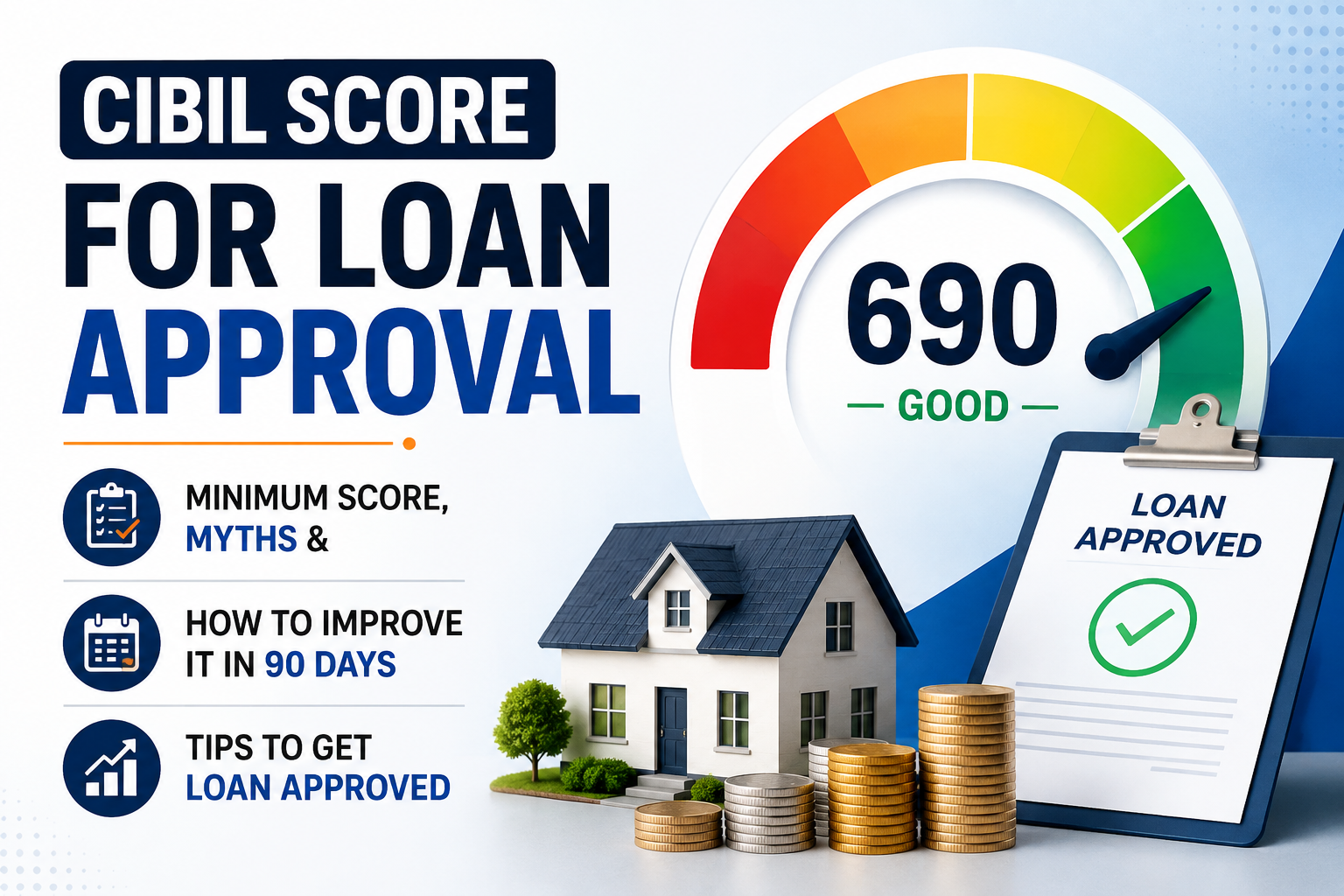
Cibil score for loan approval: minimum score, myths & how to improve it in 90 days
 Read more
A practical, easy-to-understand guide for salaried professionals, self-employed individuals, and business owners
CIBIL Score for Loan Approval: What Score Do You Really Need?
Is a CIBIL score of 690 enough to get a loan? Will a score below 700 automatically lead to rejection? Does a high score guarantee approval? These are some of the most common questions borrowers ask before applying for a personal loan, business loan, home loan, Loan Against Property (LAP), or working capital facility.
The short answer is: your CIBIL score matters, but it is not the entire loan decision.
A CIBIL Score is a three-digit summary of your credit history and ranges from 300 to 900. A higher score generally indicates a stronger credit profile and can improve your chances of getting credit. However, lenders also look at your income, repayment capacity, existing loans and credit-card obligations, payment behaviour, overall financial profile, and their own eligibility criteria.
This is exactly why a CIBIL score of 690 does not automatically mean “loan rejected.” Your score may influence the lender’s risk assessment, but the final decision depends on the complete profile.
Quick answer
There is no universal CIBIL score that guarantees loan approval. A score above 700 is generally considered good, while a higher score can strengthen your profile. But lenders can have different credit policies, and the final decision depends on multiple factors—not just one number.What Is a CIBIL Score?
Your CIBIL Score is a 3-digit numeric summary of your credit history, ranging from 300 to 900. It is generated from information in your credit report, including your accounts, repayment behaviour, and credit enquiries. The closer the score is to 900, the stronger the credit signal generally is for lenders.
Think of your CIBIL Score as one part of your financial report card. It tells a lender how you have handled credit in the past. But a lender still needs to understand whether you can comfortably repay the new loan today.
Your CIBIL report can also contain details of active and inactive loan and credit-card accounts, payment history, and lender enquiries. Reviewing the report before applying can help you spot errors or accounts that you may have forgotten about.
What Is the Minimum CIBIL Score for Loan Approval?
This is where many borrowers get confused. There is no single “minimum CIBIL score” applicable to every loan, every bank or every NBFC. Lenders use their own risk policies and may assess different factors depending on the product, loan amount, borrower profile, and repayment capacity.
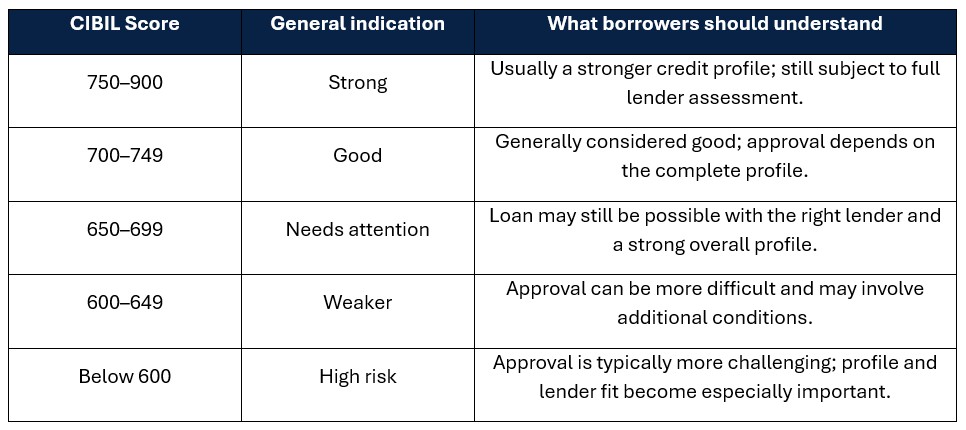
As a practical guide, a score above 700 is generally viewed as good, and a higher score can improve your chances of approval and may support better credit terms. But a score below 700 does not automatically close the door.
For example, a borrower with a 690 score may still have a viable application if the rest of the profile is strong: stable income or business cash flow, manageable existing obligations, a good repayment record, and a lender whose eligibility criteria fit the case.
Conversely, a borrower with a higher score can still face difficulty if the lender finds excessive existing debt, weak repayment capacity, unstable income, recent credit stress, or other issues.
Important
These ranges are a practical guide, not a universal lending rule. Never treat a score band as a guaranteed approval or rejection threshold.CIBIL Score 690: Is Bank Loan Approval Still Possible?
Yes, it can be possible. A 690 score is not a “game over” number. The key question is not only “What is my CIBIL score?” but “How strong is my complete loan profile?”
If your score is 690, lenders may also consider:
- Income and financial stability: Is your salary, professional income, or business cash flow stable?
- Repayment capacity: Can your current income comfortably support the proposed EMI?
- Existing loans and obligations: What are your current EMIs, credit-card balances, and other liabilities?
- Overall credit profile: What does your payment history, credit utilisation, and account conduct look like?
- Lender-specific eligibility: Does the bank or NBFC have a policy that fits your profile and loan requirements?
Why Is CIBIL Important for Loan Approval?
Lenders use credit information to understand how an applicant has handled borrowed money. A history of timely repayments can strengthen the credit profile, while late payments, high credit utilisation, and frequent credit applications can create concerns.
CIBIL itself identifies payment history, credit utilisation, age of credit, and enquiries as the main factors affecting the score. That means improving your credit profile is less about finding a “quick hack” and more about building consistent financial behaviour.
7 Common CIBIL Score Myths — Busted
Myth 1: “If my CIBIL score is low, I cannot get a loan.”
Reality: A low score can make approval harder, but it does not automatically mean every lender will reject you. Lenders assess the complete profile and apply their own eligibility criteria.
Myth 2: “A CIBIL score of 690 means my bank loan is impossible.”
Reality: Not necessarily. A 690 score may still work when income, repayment capacity, existing obligations, and overall credit behaviour are supportive and the application is matched to an appropriate lender.
Myth 3: “A high income guarantees a high CIBIL score.”
Reality: Income and credit history are different. A high earner can have a weak score if repayments are missed, while disciplined repayment behaviour can build a stronger profile regardless of income level.
Myth 4: “Checking my own CIBIL score reduces it.”
Reality: Checking your own score is a soft enquiry and does not reduce your CIBIL Score. Lender enquiries made when applying for credit are different.
Myth 5: “Closing every old credit card will improve my score.”
Reality: Closing an old account can change your credit history and available credit. Do not close old accounts blindly; consider the account’s history, fees, and your overall credit profile.
Myth 6: “Paying only the minimum credit-card amount is enough.”
Reality: Paying the minimum due may keep the account from becoming overdue, but carrying a large balance can mean higher interest costs and high credit utilisation. Managing balances responsibly is better for your overall financial health.
Myth 7: “I can fix a poor CIBIL score overnight.”
Reality: There is no guaranteed overnight fix. Improvement depends on the reasons behind the score, lender reporting and your subsequent repayment behaviour. A 90-day plan can help you build better habits and identify issues, but results vary by individual.
How to Improve Your CIBIL Score in 90 Days
A 90-day improvement plan should focus on correcting errors, controlling debt, protecting your repayment record and preparing your loan application carefully. It should not promise a fixed number of points because CIBIL score changes depend on individual credit history and lender reporting.
Days 1–30: Check, Correct and Stabilise
- Get your latest CIBIL report and review it carefully.
- Check every active and closed account, payment status, and enquiry for accuracy.
- If you find an incorrect entry, raise a dispute through the appropriate credit-report process and follow up.
- Pay overdue credit-card dues and EMIs on time going forward. Avoid adding fresh missed payments.
- Set up reminders or auto-debit for due dates so payments are not missed accidentally.
- Pause unnecessary new loan or credit-card applications while you understand your profile.
Days 31–60: Reduce Credit Stress
- Work on reducing high credit-card utilisation and avoid repeatedly reaching the limit.
- Keep existing EMIs and credit-card payments on schedule.
- Review your total monthly debt obligations against your income or business cash flow.
- Avoid becoming a guarantor or co-borrower without understanding the repayment responsibility.
- Do not take a new loan simply to create a better CIBIL score. Borrow only when the credit is genuinely required and affordable.
Days 61–90: Prepare for the Right Loan Application
- Recheck your report and confirm that disputed information has been addressed or is progressing through the relevant process.
- Maintain consistent repayment behaviour.
- Review your loan requirement, income, existing obligations, and documentation.
- Assess lender eligibility before making formal applications.
- Prefer a focused application strategy rather than sending the same loan request to many lenders at once.
Remember
A 90-day plan is a process, not a guaranteed score-increase promise. The objective is to make your profile cleaner, more disciplined, and better prepared for a lender’s assessment.What Can Quietly Hurt Your CIBIL Score?
- Repeated late or missed EMI and credit-card payments.
- Consistently high credit-card utilisation.
- Multiple credit applications in a short period.
- Ignoring incorrect or unfamiliar accounts on your credit report.
- Poor repayment behaviour on co-signed, guaranteed, or joint accounts.
- Taking on new debt without checking whether the EMI fits your cash flow.
- Applying to lenders without first understanding their eligibility criteria.
How Moksha Financial Services Can Help You Improve Your Loan Readiness
A common mistake is to approach multiple banks first and check eligibility later. If the profile is not prepared, repeated applications can create unnecessary enquiries and wasted time. Moksha Financial Services focuses on the wider financial picture so borrowers can make a more informed lending decision.
As highlighted in our CIBIL carousel, the goal is not simply to chase a number. It is to understand your financial standing, review your profile, identify suitable loan options, and connect the requirement with the right lender.
- Loan Eligibility Assessment
We assess your requirements and financial profile to identify loan options that may fit your situation.
- Profile Review & Guidance
We help you understand the strengths and gaps in your financial profile so you can prepare before making a formal application.
- Better Approval Chances Through Lender Matching
Different banks and NBFCs have different criteria. We help connect suitable profiles with lenders from our network rather than encouraging blind applications.
- Repayment Solutions
We discuss loan structures and repayment considerations with your cash flow in mind, subject to lender terms and eligibility.
- Expert Support from Application to Disbursal
Our team supports the process from documentation and lender coordination through the next steps of the application.
Need help with a 690 CIBIL score?
Do not assume that your score alone has closed the door to financing. Let Moksha Financial Services review your overall profile, understand your requirements, and help you explore suitable lender options.CIBIL Score for Business Loans: What Business Owners Should Know
For a business loan, credit profile is only one part of the lender’s assessment. Depending on the product and lender, business owners may also need to demonstrate business vintage, financial performance, banking behaviour, cash flows, existing liabilities, repayment capacity, and documentation.
That is why a business owner with a less-than-perfect CIBIL score should avoid making assumptions based on the score alone. A proper profile assessment can help identify whether the issue is the score itself, high existing obligations, insufficient repayment capacity, documentation, or simply a mismatch with the lender being approached.
How Long Does It Take to Improve a CIBIL Score?
There is no universal timeline or guaranteed number of points that every borrower will gain in 90 days. If the underlying issue is an incorrect entry, high utilisation, or recent payment behaviour, corrective action may help over time. However, the impact depends on your existing credit history and when updated information is reported by lenders.
The best approach is to use 90 days to build a cleaner repayment pattern, control credit usage, resolve reporting issues, and prepare for a suitable loan application—not to chase a specific score overnight.
Frequently Asked Questions
What is a good CIBIL score for a loan?
A score above 700 is generally considered good. However, there is no universal approval threshold. Lenders consider the score along with income, repayment capacity, existing obligations, credit history, and their own eligibility rules.
Is 690 a bad CIBIL score?
A 690 score is below the commonly used 700-plus good-score benchmark, but it does not automatically mean loan rejection. Your complete financial profile and lender fit still matter.
Can I get a loan with a CIBIL score below 650?
It can be more difficult, but approval may still be possible depending on the lender, loan product, and the rest of your profile. Do not assume that one score alone decides the outcome.
Does checking my own CIBIL score lower it?
No. Your own score check is a soft enquiry and does not reduce your CIBIL Score.
How can I improve my CIBIL score quickly?
Focus on the fundamentals: pay dues on time, reduce high credit utilisation, avoid unnecessary new credit applications, review your report for errors, and maintain disciplined credit behaviour.
Can I improve my CIBIL score in 90 days?
You can take meaningful corrective steps in 90 days, but no one can guarantee a fixed score increase in that period. The outcome depends on your starting profile, the issues involved, and updated lender reporting.
Does income affect CIBIL score?
Income is not the same thing as your CIBIL Score. However, lenders can consider income and repayment capacity separately when evaluating a loan application.
What should I do before applying for a loan with a 690 score?
Review your CIBIL report, understand your existing obligations, check repayment capacity, correct inaccuracies, avoid unnecessary applications, and explore lenders whose eligibility criteria fit your profile.
Final Takeaway: Your CIBIL Score Is Important — But It Is Not Your Whole Financial Story
If you remember only one thing from this article, remember this: a CIBIL score is an important part of a loan application, but it is not the complete application.
A 690 score does not automatically mean that the bank loan door is closed. What matters is how your score fits with your income, repayment capacity, existing obligations, credit behaviour, financial stability, and the lender’s eligibility criteria.
If your CIBIL score needs improvement, do not panic and do not apply everywhere at once. Review your report, correct errors, strengthen repayment habits, control debt, and prepare your application strategically.
And if you want professional guidance before approaching a lender, Moksha Financial Services can help you assess your loan eligibility, review your profile, identify suitable lender options, and support you through the application process.
Ready to check your loan eligibility?
Contact Moksha Financial Services Expert on +91 98935 94548 and connect with our team for guidance on your loan requirements and financial profile. -
Term loan: the smart way to fund your business growth
 Read more
In today’s fast-moving business world, access to the right kind of funding can make or break your growth journey. Whether you’re planning to expand operations, purchase machinery, hire talent, or manage working capital, having sufficient funds at the right time is crucial.
One of the most reliable and structured financing options available to businesses is a Term Loan. If you’re a business owner or entrepreneur looking for clarity on how term loans work and whether they’re right for you, this guide will help you understand everything in simple terms.
At Moksha Financial Services, we help businesses make smart financial decisions — and this blog is your step toward understanding one of the most powerful financial tools available.
What is a Term Loan?
A Term Loan is a type of loan provided by banks or financial institutions where a fixed amount of money is borrowed and repaid over a specified period, along with interest.
Unlike short-term loans or credit lines, term loans are structured with:
- A fixed repayment schedule
- A predetermined interest rate (fixed or floating)
- A defined tenure (short, medium, or long-term)
In simple words, you take a lump sum amount and repay it in EMIs over time.
Why Businesses Prefer Term Loans
Term loans are one of the most popular financing options for businesses — and for good reason.
1. Planned Financial Management
Term loans allow businesses to plan their finances effectively because the repayment schedule is fixed. This predictability helps in managing cash flow without surprises.
2. Lower Interest Rates
Compared to other funding options like credit cards or unsecured short-term loans, term loans often come with relatively lower interest rates.
3. Suitable for Big Investments
If you’re planning to invest in infrastructure, machinery, or expansion, a term loan is ideal because it provides a large amount upfront.
4. Flexible Tenure Options
Depending on your needs, you can choose short, medium, or long repayment tenures.
Types of Term Loans
Understanding the types of term loans helps you choose the right one based on your business needs.
1. Short-Term Loans
- Tenure: Up to 1 year
- Best for: Immediate business needs, working capital gaps
- Quick approval and faster repayment
2. Medium-Term Loans
- Tenure: 1 to 5 years
- Best for: Equipment purchase, business expansion
3. Long-Term Loans
- Tenure: 5 to 15 years (or more)
- Best for: Infrastructure development, large-scale investments
Each type serves a different purpose, and choosing the right one depends on your business goals.
Key Features of Term Loans
Before applying, it’s important to understand the key features:
- Loan Amount: Based on business profile and eligibility
- Interest Rate: Fixed or floating
- Repayment: Monthly EMIs
- Security: Can be secured or unsecured
- Tenure: Flexible depending on the requirement
Secured vs Unsecured Term Loans
Secured Term Loans
These loans require collateral such as property, machinery, or other assets.
Advantages:
- Lower interest rates
- Higher loan amount
- Longer tenure
Unsecured Term Loans
No collateral is required.
Advantages:
- Faster approval
- Less documentation
- Ideal for small businesses
At Moksha Financial Services, we help you choose between secured and unsecured options based on your profile.
Who Can Apply for a Term Loan?
Term loans are designed for a wide range of applicants:
- Small and Medium Enterprises (SMEs)
- Startups (with strong financials or projections)
- Proprietorship firms
- Partnership firms
- Private limited companies
Eligibility depends on factors like:
- Business vintage
- Turnover
- Profitability
- Credit score (CIBIL)
- Banking history
Documents Required for Term Loan
While documentation may vary, here are the commonly required documents:
- KYC documents (Aadhar, PAN)
- Business registration proof
- Bank statements (last 6–12 months)
- Income Tax Returns
- Financial statements (Balance Sheet, P&L)
- GST returns (if applicable)
A well-prepared documentation set increases approval chances.
How Term Loan Works (Simple Example)
Let’s understand this with a simple example:
Suppose you take a term loan of ₹10,00,000 for 5 years at an interest rate of 12%.
- You will repay the loan in monthly EMIs
- Each EMI includes both principal and interest
- Over time, the interest portion reduces while principal repayment increases
This structured repayment makes it easy to manage.
Benefits of Taking a Term Loan
1. Business Expansion
You can open new branches, increase inventory, or scale operations.
2. Asset Creation
Purchase machinery, vehicles, or equipment that adds value to your business.
3. Tax Benefits
Interest paid on business loans is often tax-deductible.
4. Improved Credit Score
Timely repayment improves your creditworthiness.
When Should You Take a Term Loan?
A term loan is ideal when:
- You have a clear business plan
- The investment will generate returns
- You can manage regular EMI payments
- You need a large amount upfront
Avoid taking a loan without a proper repayment strategy.
Common Mistakes to Avoid
Even though term loans are beneficial, many businesses make mistakes:
1. Borrowing More Than Needed
Taking a higher loan increases the EMI burden.
2. Ignoring Interest Rates
Even a small difference in rates can impact total repayment.
3. Poor Financial Planning
Not planning cash flow can lead to EMI defaults.
4. Not Comparing Options
Always compare lenders before choosing.
How Moksha Financial Services Helps You
At Moksha Financial Services, we simplify the entire loan process for you.
What We Offer:
- Personalized loan consultation
- Best lender matching
- Minimum documentation support
- Faster approval process
- End-to-end assistance
We understand that every business is unique, so we provide customized solutions tailored to your needs.
Term Loan vs CC/OD Limit
Feature Term Loan OD/CC Limit Personal Loan Purpose Business investment Working capital Personal use Repayment Fixed EMIs Flexible Fixed EMIs Interest Rate Moderate Lower (usage-based) Higher Loan Amount High Moderate Low to moderate Choosing the right loan depends on your financial requirements.
Also Read: CC Limit vs OD Limit in India: Key Differences, Benefits & Which is Better (2026)
Tips to Get Your Term Loan Approved Faster
Want quick approval? Follow these tips:
- Maintain a good CIBIL score (700+)
- Keep financial documents updated
- Show consistent bank transactions
- Avoid multiple loan applications
- Choose the right lender
With proper preparation, approval becomes much easier.
Future of Business Financing in India
With the growth of digital lending and fintech, accessing term loans has become easier than ever. Businesses no longer need to go through complicated processes.
Financial platforms and advisors like Moksha Financial Services are bridging the gap between lenders and businesses, making funding faster, smarter, and more accessible.
Final Thoughts
A Term Loan is not just a financial product — it’s a growth enabler.
If used wisely, it can help your business:
- Expand faster
- Build assets
- Improve operations
- Increase profitability
However, the key lies in choosing the right loan, the right lender, and the right repayment plan.
Ready to Grow Your Business?
If you’re planning to take a term loan and want expert guidance, Moksha Financial Services is here to help you at every step.
From understanding your requirement to getting your loan approved — we make the process simple, fast, and stress-free.
-
Cc limit vs od limit in india: key differences, benefits & which is better (2026)
 Read more
Are You Running a Profitable Business… But Still Facing Cash Shortages?
This is more common than you think.
Many businesses in India generate good sales and profits on paper, yet struggle with daily cash flow. The reason is simple — a timing mismatch between income and expenses.
Your customers may take 30–60 days to pay.
But your expenses don’t wait:- Salaries must be paid on time
- Suppliers need immediate payment
- Rent and operational costs are fixed
This creates a gap — and if not managed properly, it can slow down or even damage your business growth.
This is where two powerful financial tools come into play:
- Cash Credit (CC) Limit
- Overdraft (OD) Limit
Both are designed to solve short-term cash flow problems. But choosing the right one can make a huge difference.
Let’s understand everything in detail.
What is a Cash Credit (CC) Limit?
A Cash Credit (CC) limit is a type of working capital financing offered specifically to businesses.
Instead of giving a fixed loan amount, banks provide you with a credit limit. You can withdraw funds as needed and repay them when cash becomes available.
How CC Limit Works
The process is simple:
-
The bank evaluates your business performance
-
A credit limit is approved (for example, ₹50 lakh)
-
You use funds whenever required
-
Interest is charged only on the amount used
This makes CC a highly flexible solution for daily business needs.
Security for CC Limit
Cash Credit is usually secured against:
- Inventory (stock)
- Raw materials
- Finished goods
- Accounts receivable
Banks calculate something called drawing power, which decides how much you can withdraw based on your assets.
Example
Suppose your CC limit is ₹50 lakh.
If you use only ₹20 lakh:You pay interest only on ₹20 lakh, not the full amount.
This is one of the biggest advantages of CC.
When Should You Choose CC Limit?
A CC limit is ideal if your business:
- Deals with inventory regularly
- Requires continuous working capital
- Has daily operational expenses
- Operates in trading or manufacturing
In short, CC is built for business operations
What is an Overdraft (OD) Limit?
An Overdraft (OD) limit allows you to withdraw money from your bank account even when your balance is zero.
In simple words:
You can spend more than what you currently have
How OD Limit Works
-
The bank sanctions a limit (e.g., ₹25 lakh)
-
It is linked to your current or savings account
-
You can withdraw anytime
-
Interest is charged only on the amount used
Types of Overdraft
1. Secured Overdraft
Given against:
- Property
- Fixed deposits
- Insurance policies
- Financial investments
2. Unsecured Overdraft
- Based on income or credit profile
- Lower limits
- Higher interest rates
Who Should Use OD Limit?
OD is suitable for:
- Business owners needing flexible funds
- Professionals (CA, doctors, consultants)
- Service-based businesses
- Individuals with strong financial assets
In short, OD is about flexibility
Why Understanding the Difference Matters
Many business owners choose the wrong facility simply because they don’t understand the difference clearly.
This leads to:
- Higher interest costs
- Cash flow issues
- Financial stress
Choosing the right option = better financial control
CC Limit vs OD Limit: Key Differences Explained
Parameter Cash Credit (CC) Overdraft (OD) Purpose Working capital Flexible funding Users Businesses Businesses + Individuals Security Inventory, receivables Property, FD Account Type Separate CC account Linked to a bank account Usage Structured Flexible Monitoring Strict (stock statements) Less strict Benefits of CC and OD Limits
Both facilities offer powerful advantages when used correctly.
1. Interest Only on Utilized Amount
You don’t pay interest on the full sanctioned limit — only on what you use.
2. Flexible Withdrawals
Withdraw funds anytime based on your needs.
3. Improved Cash Flow
No stress during payment delays.
4. Continuous Access to Funds
No need to apply for loans repeatedly.
5. Supports Business Growth
Take advantage of opportunities without waiting for funds.
Real-Life Example (Why This Matters)
Let’s simplify this with a practical scenario.
A trading business was facing delayed payments from customers.
Because of this, they were unable to purchase new inventory on time.After taking a Cash Credit limit, they:
- Maintained consistent inventory
- Fulfilled orders without delay
- Improved supplier relationships
Within 6 months, their revenue increased by around 25%.
This shows how the right financial tool can directly impact growth.
Eligibility Criteria for CC/OD in India
Although criteria vary by bank, common requirements include:
- Registered business entity
- Minimum 1–3 years of operations
- Stable turnover
- Good credit score
- Proper financial records
Banks assess your financial health before approving limits.
Documents Required
KYC Documents
- PAN Card
- Aadhaar Card
- Address proof
Business Documents
- GST registration
- Business registration certificate
Financial Documents
- Income Tax Returns
- Balance sheet
- Profit & Loss statement
Banking Documents
-
Last 6–12 months bank statements
Step-by-Step Process to Apply
Step 1: Choose the Right Lender
Compare banks or financial consultants
Step 2: Submit Documents
Provide complete financial details
Step 3: Credit Evaluation
Bank checks:
- Turnover
- Profitability
- Credit history
Step 4: Limit Sanction
Loan limit is approved
Step 5: Activation
Start using funds anytime
Approval time: usually 7–15 working days
When Should You Choose CC vs OD?
This is the most important decision.
Choose CC Limit if:
- You manage inventory
- You need funds daily
- You run a trading/manufacturing business
Choose OD Limit if:
- You have property or FD
- You want flexibility
- You need emergency financial backup
Simple Rule to Remember
- CC = Business operations
- OD = Financial flexibility
Common Mistakes Businesses Must Avoid
Even though these facilities are useful, wrong usage can create problems.
- Using funds for personal expenses
- Borrowing the full limit unnecessarily
- Ignoring interest costs
- Poor financial planning
Smart usage is the key to success.
Hidden Cost of Not Using CC/OD
Many businesses avoid these facilities — and pay the price.
- Missed growth opportunities
- Delayed operations
- Supplier issues
- Cash flow stress
Not using these tools at the right time can slow your business growth.
Why Choosing the Right Financial Partner Matters
Getting approval is one thing.
Choosing the right structure is another.Many businesses face:
- Loan rejection
- Delays
- High interest rates
Because they choose the wrong product or lender.
Get Expert Help for CC/OD Limit
At Moksha Financial Services, we help businesses:
- Choose the right CC or OD option
- Get faster approvals
- Compare multiple banks
- Structure working capital efficiently
Book a free consultation and make smarter financial decisions - Apply Now
Final Thoughts
Cash flow is the backbone of every successful business.
Even profitable businesses can struggle without proper liquidity.
Both Cash Credit (CC) and Overdraft (OD) are powerful tools —
But their effectiveness depends on how you use them.???? Choose the right option
???? Use it wisely
???? And turn it into a growth engine for your businessFrequently Asked Questions (FAQs)
What is a CC limit?
A working capital facility that allows businesses to withdraw funds as needed.
What is an OD limit?
A facility that allows withdrawal beyond the available bank balance.
Which is better: CC or OD?
It depends on your business needs — CC for operations, OD for flexibility.
Is collateral required?
In most cases, yes.
How long does approval take?
Usually 7–15 working days.

CIBIL Score for Loan Approval: Minimum Score, Myths & How to Improve It in 90 Days
A practical, easy-to-understand guide for salaried professionals, self-employed individuals, and business owners
CIBIL Score for Loan Approval: What Score Do You Really Need?
Is a CIBIL score of 690 enough to get a loan? Will a score below 700 automatically lead to rejection? Does a high score guarantee approval? These are some of the most common questions borrowers ask before applying for a personal loan, business loan, home loan, Loan Against Property (LAP), or working capital facility.
The short answer is: your CIBIL score matters, but it is not the entire loan decision.
A CIBIL Score is a three-digit summary of your credit history and ranges from 300 to 900. A higher score generally indicates a stronger credit profile and can improve your chances of getting credit. However, lenders also look at your income, repayment capacity, existing loans and credit-card obligations, payment behaviour, overall financial profile, and their own eligibility criteria.
This is exactly why a CIBIL score of 690 does not automatically mean “loan rejected.” Your score may influence the lender’s risk assessment, but the final decision depends on the complete profile.
Quick answer
There is no universal CIBIL score that guarantees loan approval. A score above 700 is generally considered good, while a higher score can strengthen your profile. But lenders can have different credit policies, and the final decision depends on multiple factors—not just one number.
What Is a CIBIL Score?
Your CIBIL Score is a 3-digit numeric summary of your credit history, ranging from 300 to 900. It is generated from information in your credit report, including your accounts, repayment behaviour, and credit enquiries. The closer the score is to 900, the stronger the credit signal generally is for lenders.
Think of your CIBIL Score as one part of your financial report card. It tells a lender how you have handled credit in the past. But a lender still needs to understand whether you can comfortably repay the new loan today.
Your CIBIL report can also contain details of active and inactive loan and credit-card accounts, payment history, and lender enquiries. Reviewing the report before applying can help you spot errors or accounts that you may have forgotten about.
What Is the Minimum CIBIL Score for Loan Approval?
This is where many borrowers get confused. There is no single “minimum CIBIL score” applicable to every loan, every bank or every NBFC. Lenders use their own risk policies and may assess different factors depending on the product, loan amount, borrower profile, and repayment capacity.
As a practical guide, a score above 700 is generally viewed as good, and a higher score can improve your chances of approval and may support better credit terms. But a score below 700 does not automatically close the door.
For example, a borrower with a 690 score may still have a viable application if the rest of the profile is strong: stable income or business cash flow, manageable existing obligations, a good repayment record, and a lender whose eligibility criteria fit the case.
Conversely, a borrower with a higher score can still face difficulty if the lender finds excessive existing debt, weak repayment capacity, unstable income, recent credit stress, or other issues.
Important
These ranges are a practical guide, not a universal lending rule. Never treat a score band as a guaranteed approval or rejection threshold.
CIBIL Score 690: Is Bank Loan Approval Still Possible?
Yes, it can be possible. A 690 score is not a “game over” number. The key question is not only “What is my CIBIL score?” but “How strong is my complete loan profile?”
If your score is 690, lenders may also consider:
- Income and financial stability: Is your salary, professional income, or business cash flow stable?
- Repayment capacity: Can your current income comfortably support the proposed EMI?
- Existing loans and obligations: What are your current EMIs, credit-card balances, and other liabilities?
- Overall credit profile: What does your payment history, credit utilisation, and account conduct look like?
- Lender-specific eligibility: Does the bank or NBFC have a policy that fits your profile and loan requirements?
Why Is CIBIL Important for Loan Approval?
Lenders use credit information to understand how an applicant has handled borrowed money. A history of timely repayments can strengthen the credit profile, while late payments, high credit utilisation, and frequent credit applications can create concerns.
CIBIL itself identifies payment history, credit utilisation, age of credit, and enquiries as the main factors affecting the score. That means improving your credit profile is less about finding a “quick hack” and more about building consistent financial behaviour.
7 Common CIBIL Score Myths — Busted
Myth 1: “If my CIBIL score is low, I cannot get a loan.”
Reality: A low score can make approval harder, but it does not automatically mean every lender will reject you. Lenders assess the complete profile and apply their own eligibility criteria.
Myth 2: “A CIBIL score of 690 means my bank loan is impossible.”
Reality: Not necessarily. A 690 score may still work when income, repayment capacity, existing obligations, and overall credit behaviour are supportive and the application is matched to an appropriate lender.
Myth 3: “A high income guarantees a high CIBIL score.”
Reality: Income and credit history are different. A high earner can have a weak score if repayments are missed, while disciplined repayment behaviour can build a stronger profile regardless of income level.
Myth 4: “Checking my own CIBIL score reduces it.”
Reality: Checking your own score is a soft enquiry and does not reduce your CIBIL Score. Lender enquiries made when applying for credit are different.
Myth 5: “Closing every old credit card will improve my score.”
Reality: Closing an old account can change your credit history and available credit. Do not close old accounts blindly; consider the account’s history, fees, and your overall credit profile.
Myth 6: “Paying only the minimum credit-card amount is enough.”
Reality: Paying the minimum due may keep the account from becoming overdue, but carrying a large balance can mean higher interest costs and high credit utilisation. Managing balances responsibly is better for your overall financial health.
Myth 7: “I can fix a poor CIBIL score overnight.”
Reality: There is no guaranteed overnight fix. Improvement depends on the reasons behind the score, lender reporting and your subsequent repayment behaviour. A 90-day plan can help you build better habits and identify issues, but results vary by individual.
How to Improve Your CIBIL Score in 90 Days
A 90-day improvement plan should focus on correcting errors, controlling debt, protecting your repayment record and preparing your loan application carefully. It should not promise a fixed number of points because CIBIL score changes depend on individual credit history and lender reporting.
Days 1–30: Check, Correct and Stabilise
- Get your latest CIBIL report and review it carefully.
- Check every active and closed account, payment status, and enquiry for accuracy.
- If you find an incorrect entry, raise a dispute through the appropriate credit-report process and follow up.
- Pay overdue credit-card dues and EMIs on time going forward. Avoid adding fresh missed payments.
- Set up reminders or auto-debit for due dates so payments are not missed accidentally.
- Pause unnecessary new loan or credit-card applications while you understand your profile.
Days 31–60: Reduce Credit Stress
- Work on reducing high credit-card utilisation and avoid repeatedly reaching the limit.
- Keep existing EMIs and credit-card payments on schedule.
- Review your total monthly debt obligations against your income or business cash flow.
- Avoid becoming a guarantor or co-borrower without understanding the repayment responsibility.
- Do not take a new loan simply to create a better CIBIL score. Borrow only when the credit is genuinely required and affordable.
Days 61–90: Prepare for the Right Loan Application
- Recheck your report and confirm that disputed information has been addressed or is progressing through the relevant process.
- Maintain consistent repayment behaviour.
- Review your loan requirement, income, existing obligations, and documentation.
- Assess lender eligibility before making formal applications.
- Prefer a focused application strategy rather than sending the same loan request to many lenders at once.
Remember
A 90-day plan is a process, not a guaranteed score-increase promise. The objective is to make your profile cleaner, more disciplined, and better prepared for a lender’s assessment.
What Can Quietly Hurt Your CIBIL Score?
- Repeated late or missed EMI and credit-card payments.
- Consistently high credit-card utilisation.
- Multiple credit applications in a short period.
- Ignoring incorrect or unfamiliar accounts on your credit report.
- Poor repayment behaviour on co-signed, guaranteed, or joint accounts.
- Taking on new debt without checking whether the EMI fits your cash flow.
- Applying to lenders without first understanding their eligibility criteria.
How Moksha Financial Services Can Help You Improve Your Loan Readiness
A common mistake is to approach multiple banks first and check eligibility later. If the profile is not prepared, repeated applications can create unnecessary enquiries and wasted time. Moksha Financial Services focuses on the wider financial picture so borrowers can make a more informed lending decision.
As highlighted in our CIBIL carousel, the goal is not simply to chase a number. It is to understand your financial standing, review your profile, identify suitable loan options, and connect the requirement with the right lender.
- Loan Eligibility Assessment
We assess your requirements and financial profile to identify loan options that may fit your situation.
- Profile Review & Guidance
We help you understand the strengths and gaps in your financial profile so you can prepare before making a formal application.
- Better Approval Chances Through Lender Matching
Different banks and NBFCs have different criteria. We help connect suitable profiles with lenders from our network rather than encouraging blind applications.
- Repayment Solutions
We discuss loan structures and repayment considerations with your cash flow in mind, subject to lender terms and eligibility.
- Expert Support from Application to Disbursal
Our team supports the process from documentation and lender coordination through the next steps of the application.
Need help with a 690 CIBIL score?
Do not assume that your score alone has closed the door to financing. Let Moksha Financial Services review your overall profile, understand your requirements, and help you explore suitable lender options.
CIBIL Score for Business Loans: What Business Owners Should Know
For a business loan, credit profile is only one part of the lender’s assessment. Depending on the product and lender, business owners may also need to demonstrate business vintage, financial performance, banking behaviour, cash flows, existing liabilities, repayment capacity, and documentation.
That is why a business owner with a less-than-perfect CIBIL score should avoid making assumptions based on the score alone. A proper profile assessment can help identify whether the issue is the score itself, high existing obligations, insufficient repayment capacity, documentation, or simply a mismatch with the lender being approached.
How Long Does It Take to Improve a CIBIL Score?
There is no universal timeline or guaranteed number of points that every borrower will gain in 90 days. If the underlying issue is an incorrect entry, high utilisation, or recent payment behaviour, corrective action may help over time. However, the impact depends on your existing credit history and when updated information is reported by lenders.
The best approach is to use 90 days to build a cleaner repayment pattern, control credit usage, resolve reporting issues, and prepare for a suitable loan application—not to chase a specific score overnight.
Frequently Asked Questions
What is a good CIBIL score for a loan?
A score above 700 is generally considered good. However, there is no universal approval threshold. Lenders consider the score along with income, repayment capacity, existing obligations, credit history, and their own eligibility rules.
Is 690 a bad CIBIL score?
A 690 score is below the commonly used 700-plus good-score benchmark, but it does not automatically mean loan rejection. Your complete financial profile and lender fit still matter.
Can I get a loan with a CIBIL score below 650?
It can be more difficult, but approval may still be possible depending on the lender, loan product, and the rest of your profile. Do not assume that one score alone decides the outcome.
Does checking my own CIBIL score lower it?
No. Your own score check is a soft enquiry and does not reduce your CIBIL Score.
How can I improve my CIBIL score quickly?
Focus on the fundamentals: pay dues on time, reduce high credit utilisation, avoid unnecessary new credit applications, review your report for errors, and maintain disciplined credit behaviour.
Can I improve my CIBIL score in 90 days?
You can take meaningful corrective steps in 90 days, but no one can guarantee a fixed score increase in that period. The outcome depends on your starting profile, the issues involved, and updated lender reporting.
Does income affect CIBIL score?
Income is not the same thing as your CIBIL Score. However, lenders can consider income and repayment capacity separately when evaluating a loan application.
What should I do before applying for a loan with a 690 score?
Review your CIBIL report, understand your existing obligations, check repayment capacity, correct inaccuracies, avoid unnecessary applications, and explore lenders whose eligibility criteria fit your profile.
Final Takeaway: Your CIBIL Score Is Important — But It Is Not Your Whole Financial Story
If you remember only one thing from this article, remember this: a CIBIL score is an important part of a loan application, but it is not the complete application.
A 690 score does not automatically mean that the bank loan door is closed. What matters is how your score fits with your income, repayment capacity, existing obligations, credit behaviour, financial stability, and the lender’s eligibility criteria.
If your CIBIL score needs improvement, do not panic and do not apply everywhere at once. Review your report, correct errors, strengthen repayment habits, control debt, and prepare your application strategically.
And if you want professional guidance before approaching a lender, Moksha Financial Services can help you assess your loan eligibility, review your profile, identify suitable lender options, and support you through the application process.
Ready to check your loan eligibility?
Contact Moksha Financial Services Expert on +91 98935 94548 and connect with our team for guidance on your loan requirements and financial profile.